


笑看风云
真实的降维打击是什么?_我的网站

A | 本文来自微信公众号:金捷幡,作者:金捷幡,题图来自:AI生成 物理学的降维打击链,是从宇宙最高维的理论一路退化。
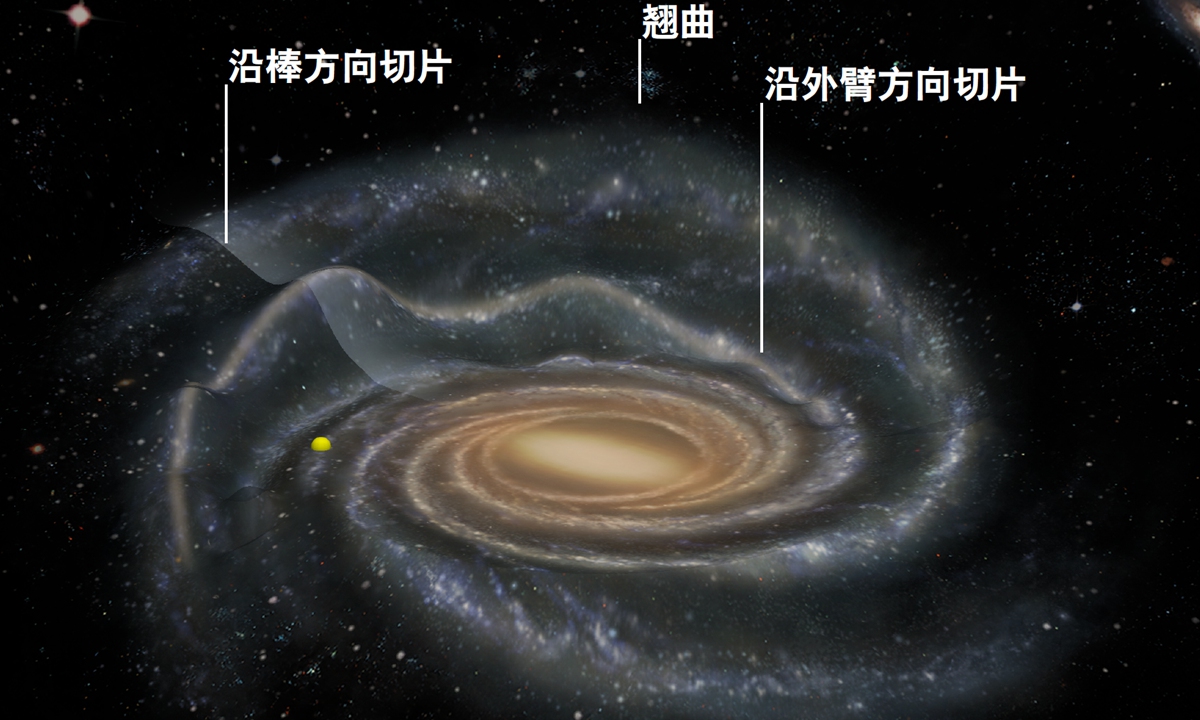
Chinese astronomers have discovered that the Milky Way is not a simple, smoothly warped disk, but contains widespread "wrinkle-like" structures resembling ripples on a water surface, providing new clues to understanding the galaxy's 3D structure and evolutionary history.
The discovery was made by a research team from the Purple Mountain Observatory (PMO) under the Chinese Academy of Sciences, using data from the "Milky Way Imaging Scroll Painting" (MWISP) survey. The findings were published online titled "Widespread corrugations superimposed on the Galactic warp in the outer CO disk" in the journal Nature Astronomy on August 7.
For decades, astronomers have known that the Milky Way's disk is not perfectly flat. Instead, its outer regions are slightly bent upward on one side and downward on the other - a structure known as a galactic warp.
However, the latest study shows that this large-scale bending is not the whole story. Smaller-scale vertical fluctuations are also embedded within the warped disk, creating a more complicated 3D structure.
"In many illustrations and in the public imagination, the Milky Way looks like a flat vinyl record," Sun Yan, associate researcher at PMO and the first author of the paper, told the Global Times on Tuesday. "In reality, the outer part of the Milky Way is more like a record that has been heated and deformed, with one side lifted and the other side lowered. That is the warp. On top of this large-scale deformation, there are additional smaller waves, which we call corrugations," Sun explained.
Using a more everyday analogy, Sun compared the Milky Way's structure to a sea surface. The warp is like a large swell that changes the overall height of the ocean, while corrugations are smaller waves superimposed on that swell.
"The two structures exist together. In our data analysis, we first removed the large-scale warp model, which allowed us to reveal the smaller wave-like patterns hidden underneath," Sun said.
The research focused on the Milky Way's outer gas disk rather than the more familiar stellar disk. According to Sun, cold molecular gas and stars provide two complementary ways to study the galaxy.
"Molecular gas is a sensitive probe for studying the vertical structure and dynamics of the galactic disk because it is concentrated near the disk plane and responds strongly to disturbances," she said.
Molecular gas is also the raw material for star formation, meaning its distribution is closely connected with the formation of young stars. The researchers traced this gas through carbon monoxide (CO) emission, which can penetrate regions obscured by interstellar dust and provide a different perspective from optical observations of stars.
The breakthrough was made possible by the MWISP survey, conducted using China's 13.7-meter millimeter-wave telescope.
"MWISP can be understood as giving the Milky Way a large-scale medical examination using millimeter-wave observations," Sun said.
Previous CO surveys were limited in sensitivity and coverage, making it difficult to accurately study the distant outer regions of the galaxy. In contrast, the latest study identified more than 30,000 molecular cloud samples, covering about half of the Milky Way's outer disk and extending to a distance of about 26 kiloparsecs from the Galactic center.
With such a large dataset, researchers were able to first establish a model of the overall warp and then separate subtle structures from the background. The newly identified corrugations have radial wavelengths of about 3.9-7.9 kiloparsecs and vertical amplitudes of about 100-200 parsecs.
The study also identified a corrugation structure extending about 40 kiloparsecs in azimuth at a distance of around 12.7 kiloparsecs from the Galactic center. In some spiral arm regions, vertical displacements can reach approximately 200 parsecs.
The researchers believe these large-scale vertical fluctuations are likely related to "bending waves" triggered by external gravitational disturbances, suggesting that the Milky Way might have experienced more complex interactions during its evolutionary history.
Although the newly discovered structures sound dramatic, they do not have any direct impact on Earth or the solar system. "Humans cannot directly sense these corrugations," Sun said. "Their scales reach thousands or even tens of thousands of light-years, and even if these structures are evolving, such changes would not be directly perceptible on human timescales."
The study focuses on the outer disk of the Milky Way and does not include the region around the solar system. "There is currently no evidence that these structures have any observable influence on Earth's environment," Sun said.
Instead, their significance lies in what they reveal about the past. Like geological layers recording Earth's history, these galactic structures preserve traces of the Milky Way's evolutionary journey, the researchers explained.
Researchers said future studies combining more precise motion measurements and numerical simulations could further reveal the origins of these structures and their role in the long-term evolution of the Milky Way.
。 它每退化一步,越接近人类的观察和对世界的理解。 但可悲的是,即使退化到最下面一层的经典理论,也有99%的人并不能真正懂。 这注定了大多数人是“愚蠢”的,那你是不是那1%呢? 第1层:M(膜)理论 维度:11维 降维:膜是多条弦凝聚而成,把它卷成圈或压成线或用其它投影这一维的方法,它会退化成弦论。

B | 第2层: 弦论 维度: 10维 降维: 10维=3D空间+1D时间+6D卡拉比–丘流形(这个丘是丘成桐)。 实数6D其实是复数的3D,是凡夫俗子看不到的微观高能世界,其几何性质决定了我们宇宙的基本粒子种类和物理常数,每个不同的卡拉比–丘流形对应一种不同的宇宙。

C | 这次降维忽略掉这紧致化的6D,剩下我们熟悉的4D低能世界。 第3层:广义相对论 维度:4维 降维:弦论在低能极限下,退化成广义相对论。弦论中的闭弦振动模式恰好对应引力子(graviton)。这保证了广义相对论的时空曲率可以从弦的量子振动自然导出。

D | 广义相对论在时空平坦和无引力时,退化成狭义相对论。 第3.5层:狭义相对论 维度:4维 狭义相对论在物体远低于光速时,退化成牛顿力学。 第4层:牛顿力学 维度:3+1维 你真的懂牛顿力学吗?(这里假装你懂绝对时空观。) 第2层弦论降维后,低能极限下看到的是连绵的表面(广义相对论的连续时空),在高能极限下看到的则是一堆跳舞的弦(粒子)。 弦长逼近0,从振动退化成点粒子,引出了第三层的其它候选人之一:量子场论。 第3层:量子场论 维度:4维 通常认为量子场论由量子杨-米尔斯理论(规范玻色子场)+希格斯机制+费米子场理论组成。 在一定条件下,量子场论退化成量子电动力学。 第3.5层:量子电动力学,1954版杨-米尔斯理论 维度:4维 在低能和非相对论极限情况下,量子电动力学退化成麦克斯韦方程。本身就是麦克斯韦扩展出的杨-米尔斯理论当然也能退化成麦克斯韦方程。 第4层:麦克斯韦方程 维度:3+1维 (这个大学生通常假装表示懂。) 众所周知,杨-米尔斯理论中的杨指杨振宁。 对比上面两个降维路径,我们当然认为杨老绝对应该是可比肩爱因斯坦宗师级的人物,但是… 可惜…… 最早的1954年版杨-米尔斯理论预测传递力的粒子质量为0,但二十年前汤川秀树就证明介子质量不是零,所以杨-米理论被一杆子打入冷宫。关键是杨老自己也解释不了为什么,虽然从数学上看这些偏微分方程是美妙的。

E | 如何将经典杨-米尔斯理论应用到量子场论,是个极其复杂的数学过程。在1970年代上半叶,科学家们终于发明了一系列高深的数学工具,他们开始相信杨-米尔斯理论的正确性,并建立了夸克模型和预言了胶子的存在,这替代了汤川那宏观层面的介子。

F | 到1979年无质量的胶子被对撞机发现,杨-米尔斯理论彻底“复活”并戴上皇冠。 但是,老版本的杨-米尔斯理论描述的是一个“经典”宇宙中的场--平滑、连续、确定性的。把经典场公式量子化,在数学上极为困难。复活该理论的物理学家创造了一些黑魔法工具来实现其在量子尺度的可计算性,但是这都建立在未被证明的数学结构上。 到今天为止,构建量子化杨-米尔斯的数学基础仍不成功,它是被克莱研究所悬赏百万美金的千禧年难题中号称最难的一个。

G | 从类似角度看,我个人觉得同样可惜的是希尔伯特。希尔伯特以一己之力做出完整广义相对论的数学解和量子力学的数学基础(希尔伯特空间)。虽然他在数学界是绝对的宗师中的宗师,但在大众眼里根本不知道他是谁。 正相反,数学不算优秀的爱因斯坦,依靠敏锐的物理直觉和洞察力,在数学上采取拿来主义,抢先于庞加莱和希尔伯特摘了大桃子。也许,数学水平的限制也是他后半生致力于大一统理论失败的主要原因之一。

H | 对比牛顿爵爷自己发明数学工具自己提出物理体系,我现在觉得爱因斯坦只能排在后面。 本文来自微信公众号:金捷幡,作者:金捷幡。
Current article:http://8i5c.nuotingqinbeimaeijin.cfd/news/20260826_492839.html
Published on:14:45:02